

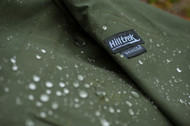
Why Hydrostatic head tests don't apply to Double Ventile® and Cotton Analogy®
Posted by David Shand on 24th Mar 2026
Hydrostatic head testing measures waterproofness by applying increasing water pressure to a fabric until water passes through, giving a result in millimetres.
It assumes a static, consistent barrier as in a membrane (like GoreTex) or a waterproof coating.
The reason hydrostatic head testing doesn’t apply to Ventile comes down to how the fabric achieves water resistance.
Ventile® is a tightly woven cotton fabric. When wet, the cotton fibres swell and close the gaps between threads, dramatically reducing water penetration. This is a dynamic, mechanical response — the fabric changes its properties upon contact with water.
Why hydrostatic testing doesn’t apply to Ventile
∙ Ventile®’s resistance increases over time as fibres swell — a hydrostatic head test applied quickly gives a very different (and misleadingly low) result than one applied after the fabric has had time to react
∙ The test measures resistance to pressure, but Ventile’s real-world protection works best against impact (rain) rather than sustained hydrostatic pressure
∙ Double Ventile® (two layers of Ventile®) and Cotton Analogy®(outer of Ventile® and inner of Nikwax Analogy®) compounds this — the air gap and layered swelling behaviour doesn’t translate into a neat pressure figure
∙ A number produced would be unrepresentative and misleading, potentially making the fabric look inferior to coated synthetics or membranes in a metric which isnt applicable.
What does this mean in practice
Double Ventile® and Cotton Analogy® perform excellently in real rain conditions but that performance simply can’t be captured by a single hydrostatic head number. It’s a case of the wrong measurement technique, not a shortcoming of the fabric.
In summary, while hydrostatic head testing is widely used to rate waterproof fabrics, it falls short when evaluating Double Ventile® and Cotton Analogy®. The unique way Ventile®’s cotton fibres react to moisture—swelling and closing gaps dynamically—means it's water resistance is more effective in real-world, rainy scenarios than in controlled laboratory tests. Therefore, relying solely on hydrostatic head figures would give an incomplete and unfair representation of Ventile®’s capabilities, as its strength lies in its evolving response to water rather than static pressure resistance.


